

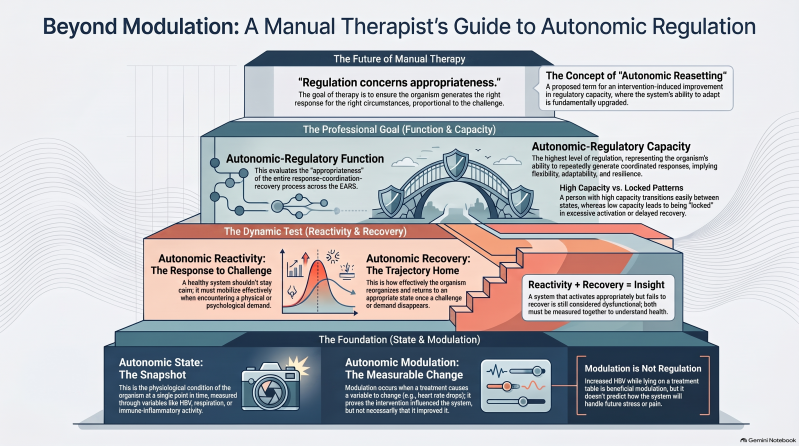
In manual therapy, interest in autonomic regulation is growing rapidly. We increasingly see studies reporting changes in heart rate variability, heart rate, blood pressure, respiration, skin conductance, cortisol, inflammatory markers or subjective relaxation following therapeutic interventions. These findings are important, but they also create a terminology problem. A measurable physiological change does not necessarily mean that regulation has improved. If we want to investigate autonomic regulation scientifically, particularly from the perspective of the Extended Autonomic Regulatory System (EARS), we need to distinguish much more clearly between autonomic state, modulation, reactivity, recovery, regulatory function and regulatory capacity.
Autonomic state refers to the physiological condition of the organism’s autonomic-regulatory system at a particular point in time. It is essentially a snapshot. Depending on what is being investigated, that state may be characterised through measures associated with the autonomic nervous system, central autonomic network, hypothalamic–pituitary–adrenal axis, neuroendocrine signalling, immune–inflammatory activity and their interactions. Importantly, no single measure defines the regulatory state of the organism. HRV, for example, can provide valuable information, but it represents only one window into a much broader regulatory system.
Autonomic modulation occurs when one or more variables within this system measurably change. A treatment might increase HRV, reduce heart rate, alter blood pressure, decrease cortisol, influence inflammatory markers or change the patient’s perceived state. This demonstrates that the intervention has influenced the autonomic-regulatory system. It does not, however, demonstrate that the system regulates better. Modulation simply tells us that something changed.
This distinction is crucial. Many interventions can produce temporary physiological changes. Slow breathing, relaxation, meditation, exercise, touch, temperature changes, posture and manual therapy can all influence components of the EARS. If HRV increases while someone is lying quietly on a treatment table, that may represent beneficial modulation, but it does not tell us how that person's regulatory system will respond when they stand up, encounter psychological stress, exercise, experience pain or face another physiological demand. Regulation is not synonymous with relaxation, reduced sympathetic activity or increased parasympathetic activity. Regulation concerns appropriateness.
This brings us to autonomic reactivity. Reactivity describes the change produced when the organism encounters a defined challenge. A healthy regulatory system should not remain physiologically calm under every circumstance. It should mobilise when mobilisation is required, conserve resources when appropriate and coordinate multiple systems according to the demands of the situation. The magnitude and pattern of that response therefore provide information that a resting measurement alone cannot provide.
Equally important is autonomic recovery – the trajectory that follows the challenge. Once the demand changes or disappears, does the organism appropriately reorganise its physiological activity? How quickly and effectively does it move towards its pre-challenge state or towards another physiologically appropriate post-challenge state? A regulatory system that activates appropriately but fails to recover may still be dysfunctional. Reactivity and recovery therefore need to be considered together.
From here we can define autonomic-regulatory function as the appropriateness of the overall response–coordination–recovery process. The question is no longer simply whether a variable increased or decreased. Instead, we ask whether the organism generated the right response for the circumstances, whether the different components of the EARS coordinated appropriately, whether the response was proportional to the challenge and whether the system reorganised effectively afterwards.
Beyond regulatory function lies autonomic-regulatory capacity. Capacity refers to the organism’s ability to repeatedly generate appropriate and coordinated regulatory responses across changing demands. It therefore implies flexibility, adaptability and resilience. An organism with greater regulatory capacity should be able to transition between physiological states according to context rather than becoming persistently locked into patterns of excessive activation, insufficient activation, delayed recovery or poor coordination between regulatory systems.
This distinction has important implications for manual therapy research. Demonstrating an immediate change in HRV, heart rate or another physiological marker after treatment allows us to say that autonomic modulation occurred. It does not yet allow us to conclude that autonomic-regulatory function or capacity improved. To make that stronger claim, research needs to examine what happens when the organism is subsequently challenged: Does it respond more appropriately? Are multiple components of the EARS better coordinated? Does recovery improve? Are these changes reproducible? Do they persist beyond the immediate treatment period? And do they translate into improved adaptability in daily life?
The terminology can therefore be viewed as a progression:
Autonomic state
A physiological condition measured at one point in time.
↓
Autonomic modulation
A measurable change in one or more components or variables of the autonomic-regulatory system.
↓
Autonomic reactivity
The change produced by a defined challenge.
↓
Autonomic recovery
The trajectory towards the pre-challenge or otherwise appropriate post-challenge state.
↓
Autonomic-regulatory function
The appropriateness and coordination of the response–coordination–recovery process across the EARS.
↓
Autonomic-regulatory capacity
The organism’s ability to generate appropriate regulatory responses across changing demands.
And perhaps, eventually, there may be another term:
Autonomic Reasetting
A proposed intervention-induced improvement in autonomic-regulatory capacity.
This last concept remains a hypothesis and must be scientifically demonstrated rather than assumed.
If an intervention merely changes HRV or reduces sympathetic activity for a short period, that is modulation. If, however, an intervention can be shown to improve how the organism subsequently responds, coordinates, recovers and adapts across changing demands, we may be observing something fundamentally different.
That is why modulation is not enough.
The important question for the future of manual therapy is not simply whether our interventions can produce measurable changes within the autonomic-regulatory system. It is whether they can improve the functioning and adaptive capacity of the Extended Autonomic Regulatory System itself.
Perhaps one day, if that phenomenon can be clearly defined, objectively measured and repeatedly demonstrated, Autonomic Reasetting will become recognised terminology for it.
Reflections by Tom Meyers, osteopath D.O. MSc., Author, Fitfull Futures Explorer and founder of The Reaset Approach and generate with the help of ChatGPT
Add comment
Comments