

Why Your Wellness Routine Might Be Backfiring
Introduction: The Search for the Magic Button
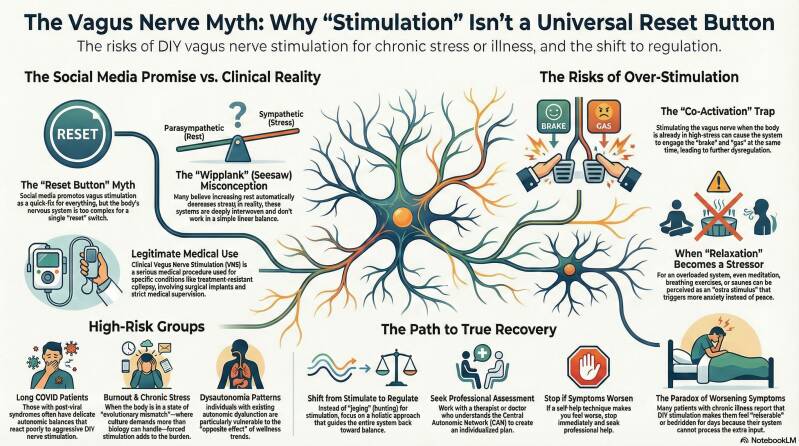
Scroll through your social media feed for more than a few minutes and you will inevitably encounter the viral siren song of the Vagus nerve "reset." From ice baths and targeted neck massages to rhythmic humming and expensive wearable gadgets, influencers and self-proclaimed health gurus promote these techniques as a biological panacea. In a culture defined by chronic overextension, the promise of a "magic button" to instantly dissolve anxiety, inflammation, and exhaustion is incredibly seductive. But behind the sleek aesthetic of the Vagus revolution, a troubling clinical reality is emerging: for many, these "hacks" aren't just failing – they are actively making things worse.
When "Relaxation" Becomes a Stressor
Inside the clinic, the fallout of the Vagus craze is becoming impossible to ignore. As an osteopath specialising in stress-related conditions, I am increasingly frustrated by the gratuitous advice circulating online. Patients often arrive defeated, reporting that they feel more anxious or physically miserable after attempting to stimulate their nervous system. For those navigating the delicate terrain of burnout or the "dysautonomia-like patterns" seen in Long COVID, these wellness hacks can be catastrophic, triggering a systemic collapse that leaves them bedridden for days.The sentiment is echoed in the mounting frustration of those seeking relief:“Because I tried it myself, but I felt more miserable because of it, I am probably doing something wrong.”This isn't a failure of the patient; it is a failure of the "quick-fix" narrative. When a system is already pushed to its limit, even well-intentioned interventions like meditation or breathing techniques can backfire, acting as a new threat rather than a release.
The Seesaw Fallacy: It’s Not a Simple On/Off Switch
The popularity of Vagus hacks rests on a fundamental misunderstanding of the Autonomic Nervous System (ANS). Many view the ANS as a simple "seesaw": on one side is the sympathetic system (the "gas pedal" of stress), and on the other is the parasympathetic system (the "brake" of rest). The logic suggests that if the stress side is too high, you simply "poke" the Vagus nerve to restore balance.This is a dangerous oversimplification. First, the Vagus nerve – while vital – is not the only parasympathetic nerve; it is merely one path within a much larger, complex parasympathetic network. Second, the ANS does not function like a playground toy. Simply increasing Vagus input does not automatically guarantee a drop in sympathetic activity.Think of it this way: focusing exclusively on the Vagus nerve is like obsessing over a single blown fuse in your basement during a neighborhood-wide power outage. You can replace that fuse as many times as you want, but if the entire grid—what clinicians call the Central Autonomic Network—is down, your lights will stay dark.
The "Gas and Brake" Trap: The Danger of Co-activation
One of the most significant risks of unregulated Vagus stimulation is a state known as "co-activation." This occurs when the body’s "brake" (the parasympathetic system) and "gas pedal" (the sympathetic system) are floored simultaneously.Because stimulating the Vagus nerve does not guarantee a drop in sympathetic stress, you can inadvertently force your body into a state where it is trying to rest and fight at the very same time. For an already overloaded nervous system, adding "one more stimulus" is often the final straw. In these cases, the body perceives the "relaxation technique" as yet another demand it cannot meet, leading to a paradoxical response that further dysregulates the system.
Clinical Reality vs. Social Media Quick-Fixes
There is a vast gulf between the "wellness" versions of Vagus stimulation found on TikTok and actual medical Vagus Nerve Stimulation (NVS). In controlled clinical settings, such as at UZ Leuven, NVS is a rigorous intervention used for treatment-resistant epilepsy. This involves surgically implanted stimulators and electrodes. It requires:
- Precise medical indications
- Ongoing professional oversight
- Meticulous dosing and monitoring of side effects
- The "one-size-fits-all" claims made by health gurus ignore these clinical boundaries. It is vital to remember that "it worked for me" is not a valid clinical guideline. What provides a minor boost for a healthy influencer can cause a total system crash in someone with underlying autonomic vulnerabilities.
From Chasing "Stimulation" to Seeking "Regulation"
True recovery doesn't come from pushing a single biological button; it requires a professional, multimodal approach. Autonomic regulation is a complex web involving the brain, the neuro-endocrine system, and the immune-inflammatory system.If your attempts at relaxation – be it saunas, meditation, or Vagus "hacks"—are causing you more stress, it is time to shift your strategy:
- Stop immediately if you notice your symptoms are worsening.
- Move away from self-experimentation and seek professional help from a practitioner who understands the whole system.
- Prioritise regulation over stimulation. Your system needs to be guided back to balance, not poked into compliance.
- Acknowledge the "System Overload" realisation. If your system is in chronic stress, it may perceive any new stimulus – even one intended for relaxation – as a threat.
Conclusion: The Deeper Question of Overload
The Vagus nerve is a masterpiece of evolution, but it is not a magic "reset button" for the ailments of caused by our modern life. While stimulation has its place in specific medical contexts, it cannot single-handedly solve the wide array of physical and mental burdens currently attributed to it.
The trend of the search for the magic button itself points to a more profound issue: Why have we become so fundamentally overloaded that the idea of a "reset button" is so desperately appealing? The answer likely lies in the "evolutionary mismatch" between our ancient biology and our high-velocity culture. We are operating with ancient hardware in a toxic environment that never sleeps. Until we address this deeper conflict between our biology and our culture, we will continue to chase hacks for a system that simply needs the space to breathe.

Tom Meyers was born in Antwerp, Belgium, in 1970. His life has been eventful, to say the least, but it came to an abrupt halt at 29 when his gourmet deli business failed, tipping him into an existential crisis. A series of questions – and the step-like process that followed – became his way out of the downward spiral. Years later, he distilled that lived experience into what he now calls Futurizing Yourself: a practical framework for overcoming limiting beliefs and designing a life you can live from, with and on purpose. Today, Tom divides his time between his Brussels-based osteopathy practice, where he specialises in autonomic regulation, and his international work as a speaker, author and the founder and instructor of The Reaset Approach – a regulation-first method that helps manual therapists bring themselves and their skills into the 21st century. Driven by a clear mission as a Fitfull Futures Explorer, he bridges health, longevity, and future readiness to help people flourish and thrive in a fast-changing world.
Add comment
Comments